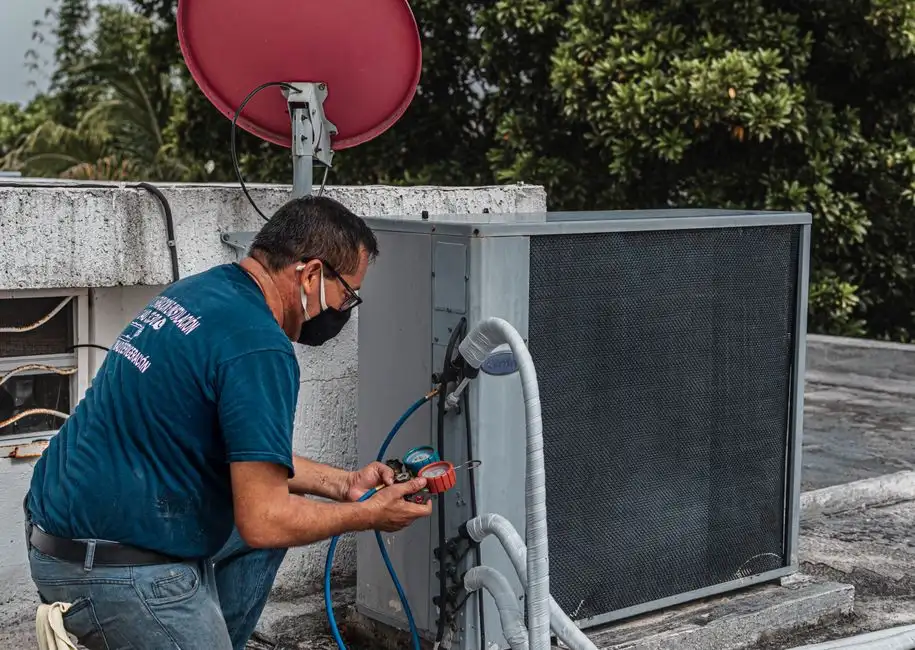
Preparing your AC for Lake Nona summer in Florida means scheduling a professional tune-up in March or April, replacing the filter, clearing the condensate drain, and confirming refrigerant charge before daily highs sit above 90°F from May through September. Do that, and your system survives the season without a mid-July breakdown. Skip it, and you join the hundreds of Lake Nona homeowners who call us in a panic when the house hits 84°F at 6 p.m.
This guide walks through the exact checklist our technicians run, what a tune-up costs in 2026, the mistakes that quietly kill compressors, and the signs that mean you should book service now rather than wait for the first heat wave.
Why Lake Nona summers punish your AC harder than most of Florida
Lake Nona sits inland from the coast, which means less ocean breeze and more heat soak than beachside neighborhoods like Cocoa or Daytona. Orlando-area summer highs routinely hit 94°F to 96°F, and the heat index climbs past 105°F on humid afternoons. Your AC runs 12 to 14 hours a day for roughly five straight months.
That run time matters. A system that cycles on and off every 20 minutes lasts longer than one that runs continuously from noon to midnight. In Lake Nona, continuous operation is the norm from June through August.
Newer construction adds its own wrinkle. Homes in Laureate Park and the surrounding villages are tight, well-insulated, and often two stories with a single zoned system. Tight construction holds cool air well, but it also traps heat in second-floor bonus rooms and lofts. If your upstairs never quite cools down, the issue is usually airflow and charge, not the thermostat setting. Homeowners we work with on HVAC Service in Laureate Park run into this every June.
Then there is the pollen and dust. Central Florida's spring pollen season dumps a fine yellow-green film on everything from February through April. That film lands on your outdoor condenser coil and your indoor evaporator coil. A dirty coil can cut cooling capacity by 20% to 30%, which means your system runs longer, pulls more amps, and wears out faster.
When should you schedule AC maintenance before Lake Nona summer?
The best time to service your AC before Lake Nona summer is late March through mid-April, before the first sustained 90°F stretch. Book it in February if you can. Our schedule fills up fast once the first hot week hits, and by May we are often booking tune-ups two weeks out.
Here is the timing that works:
- February: ideal. Technicians have open slots, and you catch problems with time to order parts.
- March to mid-April: still good. You beat the rush and get ahead of pollen season.
- Late April to May: workable, but you may wait a week or more for an appointment.
- June onward: you are in reactive mode. Every call is an emergency call, and pricing reflects that.
If you missed the spring window, do not wait until August. A tune-up in June still buys you four months of reliable cooling, and it is far cheaper than a compressor replacement.
One more thing: if your system is 12 years or older, schedule the tune-up earlier and ask the technician to check the compressor amp draw and capacitor condition specifically. Those two components fail first in Florida heat, and catching a weak capacitor during a $150 tune-up beats a $600 emergency repair in July.
The pre-summer AC tune-up checklist we run in Lake Nona
A proper pre-summer AC tune-up in Lake Nona covers 20-plus points. Here is what actually matters and what we check on every visit.
Outdoor condenser unit
- Rinse the condenser coil from the inside out to clear pollen, grass clippings, and dust.
- Straighten bent coil fins with a fin comb. Crushed fins block airflow.
- Test the capacitor and contactor. A weak capacitor is the number one cause of "AC won't start" calls in Florida.
- Check refrigerant charge with gauges and confirm subcooling is within the manufacturer's spec, usually 8°F to 12°F.
- Measure compressor amp draw against the nameplate rating.
- Clear debris from the unit's base and confirm at least 24 inches of clearance on all sides.
Indoor air handler and evaporator
- Inspect and clean the evaporator coil. In Lake Nona, this coil collects dust and biological growth faster than most homeowners expect.
- Flush the condensate drain line and test the float switch. A clogged drain in July means water damage to your ceiling.
- Check the blower motor amp draw and belt condition.
- Replace the air filter. We use MERV 8 to MERV 11 for most Lake Nona homes. Higher MERV ratings restrict airflow and can hurt performance unless your system was designed for them.
Ductwork and air distribution
- Check for disconnected or crushed flex duct in the attic. Attic temperatures hit 140°F in July, and a leaking duct dumps cold air into that heat.
- Measure static pressure and verify airflow at each register.
- Look for visible mold or moisture around supply vents.
If your ducts are more than 10 years old or you have noticed uneven cooling, air duct cleaning in Lake Nona, Florida is worth scheduling alongside the tune-up. We see a lot of construction dust still sitting in ducts in newer Lake Nona homes three and four years after move-in.
Thermostat and controls
- Verify calibration and test cooling stages.
- Check the schedule against your actual occupancy. A wrong schedule wastes 10% to 15% on cooling costs.
- If your thermostat is more than 8 years old, consider an upgrade. A modern smart thermostat installation in Lake Nona, Florida pays for itself in about two summers through better scheduling and humidity control.
How much does a summer AC tune-up cost in Lake Nona Florida?
Typical 2026 pricing for a pre-summer AC tune-up in Lake Nona runs $99 to $189 for a single system, with most homes landing around $129 to $149. Two-system homes usually pay $179 to $279 for both.
Here is what drives the range:
- Single vs. multi-system: a two-story home with a zoned system or two separate units costs more because there is twice the equipment to inspect.
- Coil condition: a heavily fouled evaporator coil adds $75 to $150 if it needs a deep chemical clean.
- Refrigerant top-off: R-410A runs $8 to $15 per ounce in 2026. A system that is two pounds low adds $250 to $450. That is not a tune-up cost, it is a leak repair, and we will tell you where the leak is before we add anything.
- Parts: a capacitor is $25 to $60 installed. A contactor is $80 to $150. Both are common replacements during a spring tune-up.
Compare that to the cost of skipping it. A compressor replacement runs $1,800 to $2,800. A full air conditioning repair in Lake Nona, Florida for a mid-summer failure typically lands between $350 and $900 depending on the part. The tune-up is the cheapest line item in the entire lifecycle of your system.
Signs your AC needs service before Lake Nona summer
Your AC is telling you it needs attention long before it quits. Watch for these signals in March and April:
- Cooling takes longer than it used to. If the house used to hit 74°F in 20 minutes and now takes 45, something changed.
- Electric bills jumped 15% or more compared to the same month last year, with no rate change.
- Warm air from some vents, cold from others. This points to a duct or airflow problem, not a refrigerant issue.
- Ice on the indoor coil or the refrigerant line. Ice means restricted airflow or low charge. Turn the system off and call us. Running it with ice on the coil damages the compressor.
- Rattling, grinding, or squealing at startup. Loose hardware, a failing blower bearing, or a bad contactor.
- Musty smell when the AC kicks on. Biological growth on the evaporator coil or in the drain pan.
- Frequent breaker trips. The compressor is drawing too many amps. This one is urgent.
Any two of these together mean you should book service this week, not next month. If your system is already down and the house is above 80°F, that is an emergency HVAC repair in Lake Nona, Florida situation, and we run those calls 24/7.
Common mistakes that shorten AC life in Lake Nona
The most expensive AC mistakes in Lake Nona are not dramatic. They are small, repeated, and easy to fix.
Running a cheap fiberglass filter for a full year. A $2 filter catches almost nothing. It lets dust through to the evaporator coil, where it mixes with condensation and turns into a mat that blocks airflow. Use a pleated MERV 8 to MERV 11 filter and change it every 60 to 90 days in summer. In a home with pets, every 45 days.
Shutting the system off when you leave. Florida humidity does not care that you are at work. Let the house hit 85°F with the AC off and your furniture, drywall, and cabinets absorb that moisture. When you turn the AC back on, it spends two hours removing water instead of heat. Set it to 78°F when you are away and let it run.
Blocking the outdoor unit. We see this constantly. Shrubs, fence panels, pool equipment, and storage bins pushed within 12 inches of the condenser. The unit needs 24 inches of clearance on all sides and 5 feet of vertical clearance above. Restricted airflow raises head pressure, and high head pressure kills compressors.
Ignoring the condensate drain until it clogs. Pour a cup of white vinegar down the drain line every three months. It costs nothing and prevents the most common water-damage call we get in July.
Setting the thermostat to 68°F hoping it cools faster. It does not. The system cools at the same rate regardless of the setpoint. You just make it run longer and pay more.
Skipping the tune-up because "it's still working." Every system is still working until it is not. The tune-up exists to find the failing capacitor, the low charge, and the clogged drain before they become a Sunday-night emergency.
What temperature should you set your AC in Lake Nona summer?
Set your thermostat to 78°F when you are home and 80°F to 82°F when you are away. That is the range the U.S. Department of Energy recommends, and it is realistic for Lake Nona humidity.
Here is the reasoning. Every degree below 78°F adds roughly 6% to 8% to your cooling cost. Dropping from 78°F to 72°F can raise a $220 summer bill to $290 or more. And in Lake Nona, the system has to run long enough to remove humidity, not just heat. A setpoint that is too low keeps the system running constantly, which shortens compressor life.
If 78°F feels warm, the problem is usually air movement, not temperature. Run ceiling fans in occupied rooms. A fan lets you set the thermostat 3°F to 4°F higher with the same comfort level. Turn fans off when you leave the room. Fans cool people, not rooms.
For sleep, 76°F to 77°F is a reasonable compromise. Set it 30 minutes before bed so the house is cool when you get in.
When to call a professional
Call a professional if your AC is more than 10 years old, if you have seen any of the warning signs above, or if you have not had the system serviced in the last 12 months. Those three conditions cover about 80% of the calls we run in Lake Nona.
Voltiva Forge handles the full pre-summer checklist in a single visit. We test the capacitor, measure refrigerant charge, clean the coils, flush the drain, and check your ductwork. If something is failing, we show you the reading and quote the repair before we touch anything. If your system is past the point where repairs make sense, we will tell you that too, and walk you through HVAC replacement in Lake Nona, Florida options with real numbers.
We also handle the rest of the year. Once summer is squared away, the same system carries you through winter, and a fall check on the heating side prevents the reverse problem in January. If you want one company for both seasons, our HVAC Service covers cooling, heating, and everything in between.
Frequently Asked Questions
How do I prepare my AC for summer in Lake Nona?
Schedule a professional tune-up in March or April, replace the filter with a MERV 8 to MERV 11 pleated filter, clear debris within 24 inches of the outdoor unit, and pour vinegar down the condensate drain. Confirm refrigerant charge and capacitor condition during the tune-up. Total cost: $99 to $189.
When should I schedule AC maintenance before Lake Nona summer?
Late March through mid-April is ideal. Book in February for the best availability. Our schedule fills two weeks out by May, and June appointments become emergency calls. If you missed spring, a June tune-up still protects you through September.
How much does a summer AC tune-up cost in Lake Nona Florida?
Typical 2026 pricing is $99 to $189 for one system, with most homes at $129 to $149. Two-system homes run $179 to $279. Refrigerant top-offs and coil deep-cleans are separate and add $75 to $450 depending on what is needed.
Why is my AC struggling in Lake Nona summer?
The three most common causes are a dirty condenser coil, low refrigerant charge from a leak, and restricted airflow from a clogged filter or crushed duct. Ice on the indoor coil points to airflow or charge. Turn the system off and call for service before the compressor is damaged.
What temperature should I set my AC in Lake Nona summer?
Set it to 78°F when home and 80°F to 82°F when away. Each degree below 78°F adds 6% to 8% to your cooling cost. Use ceiling fans to feel comfortable at 78°F instead of dropping the thermostat to 72°F.
Get help with HVAC Service in Lake Nona
Book your pre-summer tune-up before the April rush and your system will carry you through September without a surprise. Voltiva Forge runs the full checklist in one visit, quotes repairs upfront, and answers the phone when it matters.
Call (844) 796-4282 to schedule your Lake Nona AC tune-up today.